Another picture from osulmb. In the original post, this picture is labeled as being from 1962. It's one of the few color pictures I have ever seen from that early.
If it is from the 1962 season then I have no idea who the opponent is. Incredibly, we played eight home games that season, and only two on the road. So the opponent could be Colorado State, Washington State, West Texas A&M, San Jose State, Texas-El Paso, Utah State, Utah or New Mexico State.
Showing posts with label Archives. Show all posts
Saturday, April 16, 2011
The Sun Devil Photo Archive - 1967 @ Utah
Thanks to osulmb on the Sparky's Pigskin message board for these great images. Consensus is that these come from the 1967 game at Utah, which the Devils won 49-32. Love the socks!
Here's All-America Ron Pritchard coming in for a tackle:
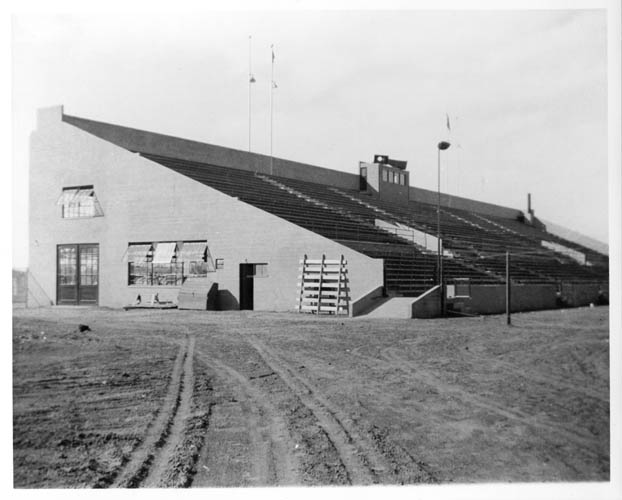
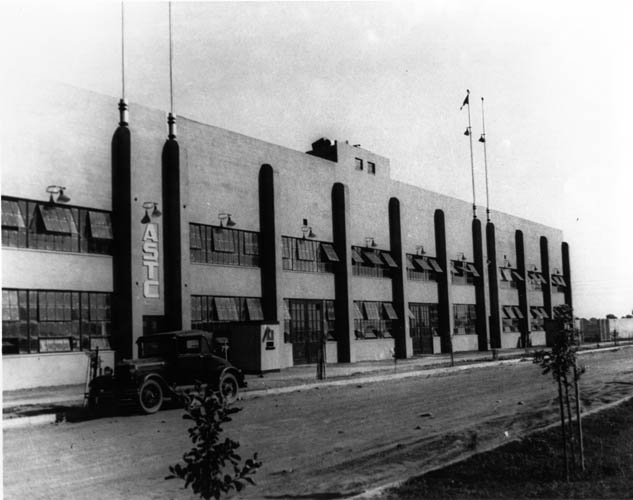
The Sun Devil Photo Archive - Goodwin Stadium
This generation of Sun Devil fans needs to preserve our heritage. It's very difficult to find a lot of photographic content on the web from anything earlier than the '90s. So when I do come across some great images I'm going to try to publicize them.
I do not want to infringe any copyright, so if you own any images used on this site please let me know and I'll be happy to remove them.
To start, here's a truly beautiful image of Goodwin Stadium. Someone sent me this link a few years ago, but I forgot to make a note of who. So thank you to the kind person, whoever you are!
Here are two more pictures of Goodwin Stadium from the ASU Libraries archive:
Please contact me if you have images you would like to post.
I do not want to infringe any copyright, so if you own any images used on this site please let me know and I'll be happy to remove them.
To start, here's a truly beautiful image of Goodwin Stadium. Someone sent me this link a few years ago, but I forgot to make a note of who. So thank you to the kind person, whoever you are!
Here are two more pictures of Goodwin Stadium from the ASU Libraries archive:
Please contact me if you have images you would like to post.
Labels:
Archives,
Football,
Goodwin Stadium,
Photographs
Sunday, March 8, 2009
Clearing the archives -- Pat Tillman (part three)
I am finally retiring the Archives page. All the content has now been published to the blog. Just click on the Archives tag link at the bottom of this article to see all the related posts.
This final set of links are resources dedicated to Pat Tillman's legacy. Most important, of course, is the Pat Tillman Foundation which organizes Pat's Run.
Kevin Tillman's essay, After Pat’s Birthday, published in October 2006, is a must-read.
The Guest Book for Pat's obituary in the Arizona Republic continues to be signed to this day, and is sobering reading. The official ASU athletics remembrance page has not been updated for a while, but is still worth referring to.
Last, but not least, is Chris Valentine's personal Pat Tillman Memorial Video.
This final set of links are resources dedicated to Pat Tillman's legacy. Most important, of course, is the Pat Tillman Foundation which organizes Pat's Run.
Kevin Tillman's essay, After Pat’s Birthday, published in October 2006, is a must-read.The Guest Book for Pat's obituary in the Arizona Republic continues to be signed to this day, and is sobering reading. The official ASU athletics remembrance page has not been updated for a while, but is still worth referring to.
Last, but not least, is Chris Valentine's personal Pat Tillman Memorial Video.
Wednesday, October 22, 2008
Clearing the archives -- Pat Tillman (part two)
Much has been written about Pat Tillman since his death. The following articles are not intended to be a comprehensive listing; rather, they form a selection that gives good perspective and provides terrific reading.
First, a basic report from MSNBC immediately following his death. Note that at this time, it was still being reported that he had been killed by enemy fire.
After his funeral, Gwen Knapp of the San Francisco Chronicle wrote an interesting article: Challenge yourself.
Tim Layden of SI wrote a tremendous personal essay Remembering Pat Tillman the morning he heard the news that Pat was dead.
Later in 2004, Layden nominated Pat as his sportsman of the year.
In September 2006, SI published Remember His Name by Gary Smith.
The fallen soldier of fortune by Adrian Wojnarowski of ESPN includes some great insight from Doug Tammaro of ASU's Sports Information Department.
First, a basic report from MSNBC immediately following his death. Note that at this time, it was still being reported that he had been killed by enemy fire.
After his funeral, Gwen Knapp of the San Francisco Chronicle wrote an interesting article: Challenge yourself.
Tillman talked about everything, with everyone. According to the speakers, he had read the Bible, the Koran, the Book of Mormon, Ralph Waldo Emerson, Henry David Thoreau, and he underlined passages constantly. Garwood recalled how he'd mail articles to friends, highlighting certain parts and writing in the margins: "Let's discuss."
Tim Layden of SI wrote a tremendous personal essay Remembering Pat Tillman the morning he heard the news that Pat was dead.
A few minutes ago my 12-year-old son walked into my home office to check on me. I turned to him, and all I could think to say was, "Pat Tillman says hello."
Later in 2004, Layden nominated Pat as his sportsman of the year.
And there I sat in my tall chair, spouting off and thinking: Tillman would despise this. He would deplore that television anchors and journalists and politicians are making a fuss over his death or worse yet, using his death to push their own agendas. With each passing live shot, I felt more out of place, more desirous of running and apologizing to Tillman's memory.
In September 2006, SI published Remember His Name by Gary Smith.
Pat just had that way, with colonels and coaches and Nobel Prize winners, too, of slicing through rank and reputation, of turning every encounter into nothing more or less than two human beings talking. Hell, the guy introduced himself to strangers simply as "Pat," and if they asked what he did before strapping it on for Uncle Sam, he'd say he studied some back at Arizona State and quickly ask about them, never mentioning the summa cum laude or the Pac-10 defensive player of the year award, and certainly not the NFL. And still, something about him made you walk away wanting to learn more, laugh more, run more, give more.
The fallen soldier of fortune by Adrian Wojnarowski of ESPN includes some great insight from Doug Tammaro of ASU's Sports Information Department.
In the year since Tillman died during a firefight in Afghanistan, Tammaro has told a thousand stories that have undoubtedly reached millions of people. He's determined to make sure that people know all about the man Tillman was, about all the dimensions of his life and character that went far beyond the headlines and sound bites centered on the million-dollar football player for the Arizona Cardinals who left it all behind in the wake of September 11th to fight for his country.
Friday, October 17, 2008
Clearing the archives -- Pat Tillman (part one)
After Pat Tillman's tragic death, I started linking to some of the better articles that had been published before he died. Of course, many great essays have been written since, but it's important to go back and read what was written while he was still with us.
A cut above was published in SI while Pat was still at ASU.
Privileged to Serve, by Peggy Noonan of the Wall Street Journal, was written after Pat had left the NFL to join the Army.
On March 20, 2003, NFL.com published an article "Tillman follows beat of a different drum" by Tom Barnidge, but this has since been removed from the site (probably just lost in the shuffle, not deliberately deleted). If anyone can find a cached version, please send me the details.
The NFL's Lonely Hero, by Paul Beston, was published in the American Spectator in December 2003. All too prophetically, Beston wrote:
Pat was killed on April 22, 2004.
A cut above was published in SI while Pat was still at ASU.
This season Tillman has become simply the best player in the country who doesn't have his own (fill in the blank: Heisman, Outland, Lombardi, Butkus) campaign, living proof that there is room at the highest level of the game for a guy without much size or blazing speed but with a brain and cojones. "He epitomizes what college football is all about," says Southern Cal offensive coordinator Hue Jackson, who was an assistant at Arizona State during Tillman's first two seasons.
Privileged to Serve, by Peggy Noonan of the Wall Street Journal, was written after Pat had left the NFL to join the Army.
Right now he has 13 weeks of basic training ahead of him, then three weeks of Airborne School, and then, if he makes it, Ranger School, where only about a third of the candidates are accepted. "It's a long row," said the Fort Benning spokesman, who seemed to suggest it would be all right to call again around Christmas. Until then he'll be working hard trying to become what he wants to become.
On March 20, 2003, NFL.com published an article "Tillman follows beat of a different drum" by Tom Barnidge, but this has since been removed from the site (probably just lost in the shuffle, not deliberately deleted). If anyone can find a cached version, please send me the details.
The NFL's Lonely Hero, by Paul Beston, was published in the American Spectator in December 2003. All too prophetically, Beston wrote:
Tillman walked away from a three-year, $3.6 million dollar contract with the Cardinals for an $18,000 salary and plentiful opportunities to get his head shot off. That hasn't happened yet, and God willing it won't. But the pay cut kicked in right away.
Pat was killed on April 22, 2004.
Wednesday, October 15, 2008
Clearing the archives -- Sparky

All ASU fans know about our beloved mascot, Sparky. For younger fans, a brief history can be found at the official site and the Walter Cronkite School of Journalism published a nice article about The real life of Sparky the Sun Devil.
Not all current Sun Devils, however, know that the school was originally known as the Owls, and later the Bulldogs. Only after the Arizona State Teachers College became a four-year school named Arizona State College did the Sun Devils moniker arrive.
By the way, Sparky has his own blog!
Friday, October 10, 2008
Clearing the archives -- the Dirk Koetter years
The Archives page will soon be gone. Today's recap starts with the announcement from November 15, 2000 that Bruce Snyder had been fired. Two weeks later, Dirk Koetter was introduced as the new head coach.
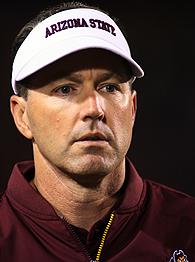
I think it's fair to say that the consensus option of Sun Devil nation at the time is that Snyder had to go. It was obvious that he had failed to keep the momentum of the 1996 season (and a pretty good 1997 season) going, and it was hard to present a solid case for his retention.
Meanwhile, Dirk Koetter was received with cautious optimism. Remember, we whisked him away from Oklahoma State at the last minute; he was certainly a hot commodity that winter. However, two red flags went up early following his hire: first, the announcement that he planned to retain the 4-2-5 defense he had used at Boise State; and second, when we saw photos of his coaching staff and realized just how young they all looked.
One thing was certain, however: Koetter was a much better selection than John Mackovic, who the Rats introduced as their new head coach at around the same time. In January, 2001, Rob Miech of SportsLine.com wrote a good piece on the challenges facing both men: Arizona schools' new coaches hope to beat heat in desert.
I think it's fair to say that the consensus option of Sun Devil nation at the time is that Snyder had to go. It was obvious that he had failed to keep the momentum of the 1996 season (and a pretty good 1997 season) going, and it was hard to present a solid case for his retention.Meanwhile, Dirk Koetter was received with cautious optimism. Remember, we whisked him away from Oklahoma State at the last minute; he was certainly a hot commodity that winter. However, two red flags went up early following his hire: first, the announcement that he planned to retain the 4-2-5 defense he had used at Boise State; and second, when we saw photos of his coaching staff and realized just how young they all looked.
One thing was certain, however: Koetter was a much better selection than John Mackovic, who the Rats introduced as their new head coach at around the same time. In January, 2001, Rob Miech of SportsLine.com wrote a good piece on the challenges facing both men: Arizona schools' new coaches hope to beat heat in desert.
"As I told people when I took the job, my number-one objective is to go and win the Rose Bowl," Mackovic said. "It has to be. If it isn't, I shouldn't be here. No one should be here. It can't be any less, because we haven't done it. It's like scaling Mount Everest. It's there, and you have to do it."Of course, things never did work out for Dirk in the desert, and six years of mediocrity later (was it really six years?) he was fired, to be replaced by his polar opposite, Dennis Erickson. The best summary of Erickson is Portrait of a winner, written by Jim Meehan of the Spokesman-Review in August, 2006, while Erickson was at Idaho. At the time of writing, the jury is out.
Wednesday, October 8, 2008
Clearing the archives -- selling out
The ongoing project to transfer the contents of the Archives to this blog continues...
You'll notice that a lot of the articles come from the New Times. Two primary reasons for this: the New Times has an extensive online history for free; and when they do cover ASU athletics, they tend to do so in depth.
Anyway, two articles today from the late 90's, both of which are still highly relevant.
In March 1998, John Dougherty's article ASU plays footsie with Nike detailed then-AD Kevin White's attempt to secure a $5 million per year deal with Nike. Funny, but 10 years later it's obvious that ASU is not one of Nike's "featured" schools. I can buy an FSU, Texas or UNC cap here in PA, but no sign of ASU merchandise.
In The Selling of ASU Football from September 1998, Dougherty reported on the commercialization of the gameday experience.
Two years later, ASU was forced to announce that they were reducing the number of in-game commercial announcements.
You'll notice that a lot of the articles come from the New Times. Two primary reasons for this: the New Times has an extensive online history for free; and when they do cover ASU athletics, they tend to do so in depth.
Anyway, two articles today from the late 90's, both of which are still highly relevant.
In March 1998, John Dougherty's article ASU plays footsie with Nike detailed then-AD Kevin White's attempt to secure a $5 million per year deal with Nike. Funny, but 10 years later it's obvious that ASU is not one of Nike's "featured" schools. I can buy an FSU, Texas or UNC cap here in PA, but no sign of ASU merchandise.
In The Selling of ASU Football from September 1998, Dougherty reported on the commercialization of the gameday experience.
The real battle during ASU home football games pits fans against a high-tech marketing machine that employs a distracting array of audio, video, live stunts and bright signage to hammer commercial messages into a captive audience.
No matter how the game unfolds, no matter the situation on the field, Sun Devil fans face a fusillade of advertisements. The ads divert attention from the field and refocus the "market" on products and corporations being hawked.
Two years later, ASU was forced to announce that they were reducing the number of in-game commercial announcements.
Thursday, September 25, 2008
Clearing the archives -- hoops edition
As we continue to retire the archives, today's selection features a recap of the roller-coaster ride that was ASU hoops from the mid '90s to the mid '00s.
The Bill Frieder era was a black mark in our program's history. I would gladly have traded the sweet sixteen appearance for some integrity. I have long argued that one of the most overlooked heroes in recent ASU history is Don Newman. We forget just how bad things were at the start of the 1997-98 history. The Sun Devils were expected to be awful on the court that year, and no one would have been very surprised had some additional scandals arisen off the court. Instead Newman led the team to an 18 win season, and NIT tournament berth, and (far more importantly) restored discipline and respect to the program. John Dougherty's article, The Stopgap Coach, published in March 1998 recaps Newman's season and the decision not to hire him as the permanent Head Coach. Others will disagree, but I said at the time, and I continue to believe that Kevin White should have had the guts to stick with him -- he earned it. I'm glad that things worked out well for him, and he has been an assistant coach for the San Antonio Spurs for several years now.
Kevin White's "splashy" hire was, in retrospect, a mistake. Rob Evans was the classic example of a great guy who could not, for whatever reason, take the program to the next level. At least he continued to improve the school's reputation in the national media, as evidenced by articles like this one from 1999 and another in 2001.
The Evans era peaked in 2003 with the NCAA tournament selection, as captured beautifully in Paul Rubin's essay Winning Season: Devils go dancing for the first time in years.
After eight years, Lisa Love fired Rob Evans and surprised pretty much everyone with her hiring of Herb Sendek. So far, so good.
The Bill Frieder era was a black mark in our program's history. I would gladly have traded the sweet sixteen appearance for some integrity. I have long argued that one of the most overlooked heroes in recent ASU history is Don Newman. We forget just how bad things were at the start of the 1997-98 history. The Sun Devils were expected to be awful on the court that year, and no one would have been very surprised had some additional scandals arisen off the court. Instead Newman led the team to an 18 win season, and NIT tournament berth, and (far more importantly) restored discipline and respect to the program. John Dougherty's article, The Stopgap Coach, published in March 1998 recaps Newman's season and the decision not to hire him as the permanent Head Coach. Others will disagree, but I said at the time, and I continue to believe that Kevin White should have had the guts to stick with him -- he earned it. I'm glad that things worked out well for him, and he has been an assistant coach for the San Antonio Spurs for several years now.Kevin White's "splashy" hire was, in retrospect, a mistake. Rob Evans was the classic example of a great guy who could not, for whatever reason, take the program to the next level. At least he continued to improve the school's reputation in the national media, as evidenced by articles like this one from 1999 and another in 2001.
The Evans era peaked in 2003 with the NCAA tournament selection, as captured beautifully in Paul Rubin's essay Winning Season: Devils go dancing for the first time in years.
After eight years, Lisa Love fired Rob Evans and surprised pretty much everyone with her hiring of Herb Sendek. So far, so good.
Wednesday, September 24, 2008
Clearing the archives
Back in the early days of Wired Devils, I maintained an Archives page where I could save links to articles of interest related to ASU athletics.
Blogging has rendered this page obsolete, so in a series of articles over the coming weeks I am going to post summaries of the archives and eventually retire the page.
We start with a couple of classics. In 1994 New Times writer Paul Rubin followed the baseball team from opening day in January until the last out at the College World Series. Coach Jim Brock died of cancer on June 12, four days after his team's season ended.
Rubin's first story BROCK SOLID was written before the legendary coach's death.
Blogging has rendered this page obsolete, so in a series of articles over the coming weeks I am going to post summaries of the archives and eventually retire the page.
We start with a couple of classics. In 1994 New Times writer Paul Rubin followed the baseball team from opening day in January until the last out at the College World Series. Coach Jim Brock died of cancer on June 12, four days after his team's season ended.Rubin's first story BROCK SOLID was written before the legendary coach's death.
"Jim Brock's place in the pantheon of all-time-great college baseball coaches is secure."The second piece, JIM BROCK LIVED FOR BASEBALL, was published a couple of weeks after he passed.
"The old baseball coach sits motionless in his chair, appearing sadly fragile. He is running on fumes now, his body wracked with liver and colon cancer that will snatch his life in just eight days."Many years later Rubin wrote a fascinating piece on Brock's successor, Pat Murphy.
Labels:
Archives,
Baseball,
Jim Brock,
Pat Murphy,
Wired Devils
Subscribe to:
Posts (Atom)